
Thursday, March 09, 2006

Wednesday, March 08, 2006
More Mazeppa De-brief
A: so, not a lot of love for Mazeppa production wise
J: in general or the T review?
A: basically all the press coverage was anti it seems
A: and Sieglinde
J: huh
J: I would never have thought intergalactic
A: yeah...I don't know where he got that
A: I guess the ponytails are kind of star trek in a way
A: but the cossacks came up with it first
J: right
J: he had lots of nice things to say about the opera and the singers at least
J: whoa
J: the original concept of Maria cradling Andrei but not knowing who he is is pretty neat too
J: damn
J: I fucking loved that opera
A: yeah
A: that is great
A: the way they did it with her singing to the freaky mannequin thing, while it worked, is kind of less dark than that
A: huh
A: there seems to be really only one modern recording of it
A: with Gergiev
J: yeah some of the same singers are on it I think
A: oh wait...there's also this from 1994
J: nice cover
A: hello 1994
J: I just sent you an mp3 of Ghena Dimitrova singing the end of Mazeppa
A: whoa
A: lovely
J: it is not as drawn out and wonderful as it is in the actual opera. it is off some recital disc.
A: right
A: I can't believe its two years til that Salome
J: wait which Salome
J: we shd go next year to the Voigt one in Chicago
A: the Met one
A: with Mattila I guess?
A: that is going to be one hot f'ing ticket
J: totally
A: you will have to keep it away from the others lest they get singed
J: hah
J: in general or the T review?
A: basically all the press coverage was anti it seems
A: and Sieglinde
J: huh
J: I would never have thought intergalactic
A: yeah...I don't know where he got that
A: I guess the ponytails are kind of star trek in a way
A: but the cossacks came up with it first
J: right
J: he had lots of nice things to say about the opera and the singers at least
J: whoa
J: the original concept of Maria cradling Andrei but not knowing who he is is pretty neat too
J: damn
J: I fucking loved that opera
A: yeah
A: that is great
A: the way they did it with her singing to the freaky mannequin thing, while it worked, is kind of less dark than that
A: huh
A: there seems to be really only one modern recording of it
A: with Gergiev
J: yeah some of the same singers are on it I think
A: oh wait...there's also this from 1994
J: nice cover
A: hello 1994
J: I just sent you an mp3 of Ghena Dimitrova singing the end of Mazeppa
A: whoa
A: lovely
J: it is not as drawn out and wonderful as it is in the actual opera. it is off some recital disc.
A: right
A: I can't believe its two years til that Salome
J: wait which Salome
J: we shd go next year to the Voigt one in Chicago
A: the Met one
A: with Mattila I guess?
A: that is going to be one hot f'ing ticket
J: totally
A: you will have to keep it away from the others lest they get singed
J: hah
Tuesday, March 07, 2006
Mad about Mazeppa
Let me be the second (of people sur les internets at least) to applaud the Met for turning in a stunner with the house debut of Tchaikovsky's Mazeppa last night.
It should be noted that both opera and production take an Act to really get warmed up. There's a considerable amount of exposition to take care of, and also funny hair pieces to come to terms with, and, while enjoyable enough, the overall impression is neither here nor there. There's also the requisite "cossack feast dance" number which is about exactly as entertaining as you're thinking. It is done in super shiny gold Hammer pants, but they don't help that much.
That said, from the Act II curtain on, the show takes off and never looks back. The hour and a half or so of the Second Act is tightly constructed opera goodness of the highest order, while Act III is shivery and haunting and stays with you for a long time. It's the kind of story which only the Russians really do right--the ruthless excercise of power, descents into madness, an unflinching pessimism about the human condition--and all driven by Tchaikovsky's riveting, endlessly inventive score. Highlights include an off the hook extended aria for Mazeppa in Act II (the splendid Nikolai Putilin); more or less every time Olga Guryakova opens her mouth, but especially her sweet insane lullaby in Act III; and a fantastic chorus number opening the third scene of the second Act--the scene culminating in a finale which left me literally slack jawed. Miss this, and you are simply forsaking one of the most hair raising moments of the season.
And no doubt that hanging jaw owes a lot to this tour de force production by Yuri Alexandrov, with sets by George Tsypin. As mentioned before, the first Act has some missteps, but the other two compensate for that in spades. The design here has a logic of its own that one might be inclined to resist at first. Everything is over the top, the connections are often dim, the colors are impetuous and sometimes maddening, the textures veer wildly between the opulent and the cheap...did I mention we're in Russia? Exactly. This is stagecraft that smuggles itself piece by piece into your brain then suddenly congeals and steps on all your neurons at once.
The big weak link of the cast was tenor Oleg Balashov, who redeemed himself un peux in the end, but just couldn't pull it together for the most part.
Back to the praise tho--not that I have much for comparison, but I thought Gergiev did a splendid job in the pit, pulling all the crazy outsized drama and pinpoint articulation to be had from the vast varied score. Shout out to the full Met brass complement, who crowded into the pit for the barn-burner "Battle of Poltava" prelude to the third act.
Methinks the only real questions remaining are A) why the hell did this take so long to get produced and B) when are your tickets?
Update: Jeez. Well apparently the production (tho not the performance) didn't go over so well in other, if not most, quarters. Sieglinde, Tommasini, the Philly Inquirer, and the Sun all take turns busting on Alexandrov/Tsypin. (On a different note, one Vivien Schweitzer at Bloomberg opines that now that New York has finally seen this long-neglected masterpiece, the Met really ought to think about cutting it due to the many empty seats in that third act. Riiight...OK...don't you have a bond market to cover or something ?)
I'll reiterate that the first act, which seems to be coming in for the lion's share of demerits, had its problems, and would agree that Tsypin is very possibly suffering from a case of acute scrim use disorder (ASUD). But on the whole, I maintain this is a legitimate reimagining that never conflicts with the opera's intent. Plus, it makes some bona fide big theatrical gambles work in the opera house, without distracting from the flow of the performance (except for maybe the too noisy snow)--not easy to do.
Oh, and just a note to R&J--don't you worry about Tommasini calling this 'intergalactic'. You're still the hands down front runner for best 2005-2006 operatic salute to Carl Sagan. And no cossack in a mylar miniskirt is goining to take that away from you.
It should be noted that both opera and production take an Act to really get warmed up. There's a considerable amount of exposition to take care of, and also funny hair pieces to come to terms with, and, while enjoyable enough, the overall impression is neither here nor there. There's also the requisite "cossack feast dance" number which is about exactly as entertaining as you're thinking. It is done in super shiny gold Hammer pants, but they don't help that much.

That said, from the Act II curtain on, the show takes off and never looks back. The hour and a half or so of the Second Act is tightly constructed opera goodness of the highest order, while Act III is shivery and haunting and stays with you for a long time. It's the kind of story which only the Russians really do right--the ruthless excercise of power, descents into madness, an unflinching pessimism about the human condition--and all driven by Tchaikovsky's riveting, endlessly inventive score. Highlights include an off the hook extended aria for Mazeppa in Act II (the splendid Nikolai Putilin); more or less every time Olga Guryakova opens her mouth, but especially her sweet insane lullaby in Act III; and a fantastic chorus number opening the third scene of the second Act--the scene culminating in a finale which left me literally slack jawed. Miss this, and you are simply forsaking one of the most hair raising moments of the season.
And no doubt that hanging jaw owes a lot to this tour de force production by Yuri Alexandrov, with sets by George Tsypin. As mentioned before, the first Act has some missteps, but the other two compensate for that in spades. The design here has a logic of its own that one might be inclined to resist at first. Everything is over the top, the connections are often dim, the colors are impetuous and sometimes maddening, the textures veer wildly between the opulent and the cheap...did I mention we're in Russia? Exactly. This is stagecraft that smuggles itself piece by piece into your brain then suddenly congeals and steps on all your neurons at once.
The big weak link of the cast was tenor Oleg Balashov, who redeemed himself un peux in the end, but just couldn't pull it together for the most part.
Back to the praise tho--not that I have much for comparison, but I thought Gergiev did a splendid job in the pit, pulling all the crazy outsized drama and pinpoint articulation to be had from the vast varied score. Shout out to the full Met brass complement, who crowded into the pit for the barn-burner "Battle of Poltava" prelude to the third act.
Methinks the only real questions remaining are A) why the hell did this take so long to get produced and B) when are your tickets?
Update: Jeez. Well apparently the production (tho not the performance) didn't go over so well in other, if not most, quarters. Sieglinde, Tommasini, the Philly Inquirer, and the Sun all take turns busting on Alexandrov/Tsypin. (On a different note, one Vivien Schweitzer at Bloomberg opines that now that New York has finally seen this long-neglected masterpiece, the Met really ought to think about cutting it due to the many empty seats in that third act. Riiight...OK...don't you have a bond market to cover or something ?)
I'll reiterate that the first act, which seems to be coming in for the lion's share of demerits, had its problems, and would agree that Tsypin is very possibly suffering from a case of acute scrim use disorder (ASUD). But on the whole, I maintain this is a legitimate reimagining that never conflicts with the opera's intent. Plus, it makes some bona fide big theatrical gambles work in the opera house, without distracting from the flow of the performance (except for maybe the too noisy snow)--not easy to do.
Oh, and just a note to R&J--don't you worry about Tommasini calling this 'intergalactic'. You're still the hands down front runner for best 2005-2006 operatic salute to Carl Sagan. And no cossack in a mylar miniskirt is goining to take that away from you.
Thursday, March 02, 2006
Samson to Ewa Podles: You are My Destino
Working Backward.
Echoing the sentiments of Alex and Maury: Must I really write about La Forza del Destino? What a mess. Not the performance really, just....you know...the opera. I don't know it very well, but I imagine the VOX recording I purchased for reference off Amazon for $1.99 will remain in its plastic shrink wrap.
Voigt sounded great, especially her splendid fourth act. So, I suppose all was not lost. Though why on earth her Met season consists of Leonora in this creaky heap of a production and a few Toscas (Tosce?) remains unclear. And knowing I have to wait a year to hear her sing something I am excited about only enhances the frustration.
Licitra--I don't totally get the deal with him. His Radames earlier this season was at least of consistent tone and of seemingly healthy vocal production. Tuesday night was like....well, you know in college how on the night before finals a lot of schools do this thing where like everyone leans out of their dorm room and lets out stress by screaming at a predetermined time?--the "primal scream" is what we called it at Columbia. Well, Licitra walked a fine line between singing the role of Alvaro, and doing the pre-finals primal scream. Both are neat. But I just found it so baffling. It is one of the most tense, uncomfortably produced vocal sounds I have heard in a long time. Yet, when it frees up it is absolutely glorious. So, there is clearly some sort of inconsistency in technique here. There is no way he is going to be able to keep this up. I predict he will have blown out what he has left within 2-3 seasons.
Delavan and Ramey both turned in listenable if unremarkable performances. Though in a couple of musically and dramatically dreadful moments, I was able to entertain myself by counting the pulses per second in Ramey's vibrato. I think he averaged about 2-3.
I can barely remember what I had for dinner last night (tho I think it was honey baked ham and american cheese on a roll, Kettle chips, and a seltzer), but I can certainly remember what I did on Sunday. I had my first real introduction to the astonishing Ewa Podles. Singing with the not-great-but-perfectly-good Moscow Chamber Orchestra, Ms. Podles had the crowd in a shockingly undersold Avery Fisher Hall screaming like a stadium full of me at a Dolora Zajick concert...er...point being, the crowd went wild. Like, insanely wild.
And never has a wild crowd been more justified. WOW. This is a f***ing magnificent voice. I mean, the woman sings like a fine baritone. She has richness and power in the lowest of registers--to a seriously shocking extent. There is almost something a bit freakish about it. But in the end, completely wonderful. On the program: A Rossini Cantata from Joan of Arc, Mussorgsky's Songs and Dances of Death, and works for chamber orchestra by Haydn, Prokofiev, and Shostakovich. Ms. Podles also did two encores, not in the program--one of which I know was by Tchaikovsky, though I missed the title. Brava.
Kicking off my mezzotastic last weekend were Clifton Forbis and *Olga Borodina* in Samson et Dalila. . It's a swell opera; not my favorite. Clif and Olg's really delivered, however, and I was glad I spent the 3.5 hours in standing room orchestra. A first. Despite the inflated labia on display on the drop at the top of act II. Not only that, but it was my first time ever at the Met on a broadcast day! What a treat. The afternoon's "DVD Extras" were a panel with Rufus Wainwright, and of course the quiz.
Ok, I am running out of steam. Question: Where does Margaret Juntwait hide at those things?
Answer: (She is a disembodied voice)
Echoing the sentiments of Alex and Maury: Must I really write about La Forza del Destino? What a mess. Not the performance really, just....you know...the opera. I don't know it very well, but I imagine the VOX recording I purchased for reference off Amazon for $1.99 will remain in its plastic shrink wrap.
Voigt sounded great, especially her splendid fourth act. So, I suppose all was not lost. Though why on earth her Met season consists of Leonora in this creaky heap of a production and a few Toscas (Tosce?) remains unclear. And knowing I have to wait a year to hear her sing something I am excited about only enhances the frustration.
Licitra--I don't totally get the deal with him. His Radames earlier this season was at least of consistent tone and of seemingly healthy vocal production. Tuesday night was like....well, you know in college how on the night before finals a lot of schools do this thing where like everyone leans out of their dorm room and lets out stress by screaming at a predetermined time?--the "primal scream" is what we called it at Columbia. Well, Licitra walked a fine line between singing the role of Alvaro, and doing the pre-finals primal scream. Both are neat. But I just found it so baffling. It is one of the most tense, uncomfortably produced vocal sounds I have heard in a long time. Yet, when it frees up it is absolutely glorious. So, there is clearly some sort of inconsistency in technique here. There is no way he is going to be able to keep this up. I predict he will have blown out what he has left within 2-3 seasons.
Delavan and Ramey both turned in listenable if unremarkable performances. Though in a couple of musically and dramatically dreadful moments, I was able to entertain myself by counting the pulses per second in Ramey's vibrato. I think he averaged about 2-3.
I can barely remember what I had for dinner last night (tho I think it was honey baked ham and american cheese on a roll, Kettle chips, and a seltzer), but I can certainly remember what I did on Sunday. I had my first real introduction to the astonishing Ewa Podles. Singing with the not-great-but-perfectly-good Moscow Chamber Orchestra, Ms. Podles had the crowd in a shockingly undersold Avery Fisher Hall screaming like a stadium full of me at a Dolora Zajick concert...er...point being, the crowd went wild. Like, insanely wild.
And never has a wild crowd been more justified. WOW. This is a f***ing magnificent voice. I mean, the woman sings like a fine baritone. She has richness and power in the lowest of registers--to a seriously shocking extent. There is almost something a bit freakish about it. But in the end, completely wonderful. On the program: A Rossini Cantata from Joan of Arc, Mussorgsky's Songs and Dances of Death, and works for chamber orchestra by Haydn, Prokofiev, and Shostakovich. Ms. Podles also did two encores, not in the program--one of which I know was by Tchaikovsky, though I missed the title. Brava.
Kicking off my mezzotastic last weekend were Clifton Forbis and *Olga Borodina* in Samson et Dalila. . It's a swell opera; not my favorite. Clif and Olg's really delivered, however, and I was glad I spent the 3.5 hours in standing room orchestra. A first. Despite the inflated labia on display on the drop at the top of act II. Not only that, but it was my first time ever at the Met on a broadcast day! What a treat. The afternoon's "DVD Extras" were a panel with Rufus Wainwright, and of course the quiz.
Ok, I am running out of steam. Question: Where does Margaret Juntwait hide at those things?
Answer: (She is a disembodied voice)
The Destino Made Me Do It
Look...I'm sorry, but that opera is kind of weak. It's not that I had a bad time per se, but all in all Verdi just f's up a little here. I mean, Forza is certainly sitting on top of a very wonderful, tho maybe not top 5, three-hour opera, but you can't really get around those clunker chorus scenes, can you?
And it's not like the man couldn't write a kick-ass chorus scene. I mean, he pretty much stands alone on that count. But the chorus scenes here ain't like that. With the exception of the tavern sequence in the second act, which seemed promising, they are dramatic lame ducks. It's like he meant to splice the chorus bits with the adjacent ensemble numbers, but the two got separated at birth and are now living on opposite sides of the country, totally unaware of the other yet making uncannily similar life choices.
I don't put much stock in some other criticisms I've seen floated. Apart from the fact that he is an *Incan prince*, the plot is hardly more contrived than a lot of other Verdi stories (one question tho--why does she refuse to go into the convent in Act II? J suggests: she wants to keep open "the option of boning").
I think the drawn out plot structure is very interesting. Especially in Alvaro, Verdi is masterful at creating music for the same character from radically different vantage points. With obvious exceptions, most of Verdi's characters really do unfold in a short time frame, and it is neat watching his style succeed in describing a bigger arc.
The trouble is he seems to feel this isn't enough to effect the passage of time. Instead of broadening the scope however, the detours from the central action just make the whole thing feel artificially inflated and dramatically unsatisfying.
But then again, Verdi doesn't really need my markings at this point, now does he?
The current production is fine, but nothing to write home about. The painfully literal set does its job save for the dopey effects in the battle scene (J: I thought Les Miz closed?) and the schlocky mountain hermitage in the last.
DVoigt sounded good, but it wasn't until her late appearance that I thought she got voigt-tastic--and even then, still somewhere short of a voigt-sation. Also, a bit hard to appreciate the new bod under a burlap sack monk get-up. Licitra has a very big pretty sound, so it is too bad that he A) insists on pushing the stuffing out of some top notes, and B) seems to randomly decide he just don't give a fuck about ending a phrase cleanly. G thought Delavan wasn't at his best, and I can see that. Still very nice tho.
Update: Maury gives it an extended 'meh' here.
And it's not like the man couldn't write a kick-ass chorus scene. I mean, he pretty much stands alone on that count. But the chorus scenes here ain't like that. With the exception of the tavern sequence in the second act, which seemed promising, they are dramatic lame ducks. It's like he meant to splice the chorus bits with the adjacent ensemble numbers, but the two got separated at birth and are now living on opposite sides of the country, totally unaware of the other yet making uncannily similar life choices.
I don't put much stock in some other criticisms I've seen floated. Apart from the fact that he is an *Incan prince*, the plot is hardly more contrived than a lot of other Verdi stories (one question tho--why does she refuse to go into the convent in Act II? J suggests: she wants to keep open "the option of boning").
I think the drawn out plot structure is very interesting. Especially in Alvaro, Verdi is masterful at creating music for the same character from radically different vantage points. With obvious exceptions, most of Verdi's characters really do unfold in a short time frame, and it is neat watching his style succeed in describing a bigger arc.
The trouble is he seems to feel this isn't enough to effect the passage of time. Instead of broadening the scope however, the detours from the central action just make the whole thing feel artificially inflated and dramatically unsatisfying.
But then again, Verdi doesn't really need my markings at this point, now does he?
The current production is fine, but nothing to write home about. The painfully literal set does its job save for the dopey effects in the battle scene (J: I thought Les Miz closed?) and the schlocky mountain hermitage in the last.

DVoigt sounded good, but it wasn't until her late appearance that I thought she got voigt-tastic--and even then, still somewhere short of a voigt-sation. Also, a bit hard to appreciate the new bod under a burlap sack monk get-up. Licitra has a very big pretty sound, so it is too bad that he A) insists on pushing the stuffing out of some top notes, and B) seems to randomly decide he just don't give a fuck about ending a phrase cleanly. G thought Delavan wasn't at his best, and I can see that. Still very nice tho.
Update: Maury gives it an extended 'meh' here.
Tuesday, February 28, 2006
Gheorghiu, Destroyer of Worlds
 I know everyone and their mother did this at the beginning of the month, but I finally got to the Gheorghiu Traviata. And she wrecked me, yo.
Perhaps it is her uncanny ability to know when to throw away a phrase in the service of a bigger payoff; perhaps it is the fact she has, say, a bjillion different vocal colors at her disposal to match every emotional nuance; perhaps it is that sterling silver knife through butter top that never fails to surprise and shatter.
Whatever the cause may be, by the third act she had ditched this mortal coil of sad opera death and become herself a whole new universe of soul-wrenching opera sad. Such that I wanted to tell her very wonderful but still terrestrial fellow principles, Jonas Kaufmann and Anthony Michaels-Moore, to stop yelling at the dying woman.
It doesn't necessarily work at all times. I got that she wasn't going to break character just to give the one random set piece number the what for, but her Sempre Libera still sounded insubstantial against the confidence one desires there. I didn't notice so much on the broadcast, however--perhaps the mics ironed out the inconsistencies caused by singing to the back of the stage so much.
But WHATEVER. Anyone who can take those well trod notes and make me weep into my Met-titles like a little girl is genius.
Sunday, February 26, 2006
Pasion
A little behind the curve on Tuesday's "Pasion" but shall interject nonetheless.
I enjoyed the Pasion this time even more, I think, than I did two years ago at BAM. The star of the show is really the glorious choral writing, where Golijov's skills of hybridization shine the most. A-Ross ain't kidding when he mentions Bach in this review of the work's 2001 premiere. The double-choir numbers especially are as powerful and integral to this work as their counterparts are in the Matthew passion. While the material is basically the Latin American pop sound that appears in a purer form elsewhere in the piece, the counterpoint and and rhythmic complexity of the choral parts consistently bring them further into unexplored territory.
Tuesday night presented an exceptionally strong showing. The orchestra was brilliant. Spano was great, very confident and precise without giving up any looseness.
The soloists were consistently strong, especially Reynaldo Gonzalez Fernandez. At times I loved Luciana Souza...at others I wondered what it would be like to have a more consistent voice doing the part. Some things lost, some things gained I imagine. She also probably suffered the most from too noticeable amplification. I feel there's a future for this piece where the amplification is perfectly deployed only to properly balance the electric instruments. This wasn't quite there yet. As for Ms. Anne-Carolyn Bird, what can be said about the sheer purity and heart breaking sweetness in that voice in the big "Lua Descolorida" aria? It made my room spin. But then again, she met David Bowie so she probably doesn't need my props.
I recall that after the BAM production I was fairly anti- the dramatic lighting and choreography elements, which I found half-assed. I didn't feel as strongly this time. I think the quasi-stagey elements make one focus on the importance of experiencing this live. Still, I would be interested to see the piece really set on its own two feet, perhaps with some slight cuts in the dance improvisation parts. I would venture it can more than handle it, and it would no doubt serve as a boon to the work's longevity.
As to the question of what the "Pasion" is exactly...I don't put much stock in the whole "Golijov is teaching classical music how to be entertaining and forcing it to reckon with popular sounds" line, whcih strikes me as too easy and several times too broad. I think it's better understood as a sort of musical conceptual art piece--through the careful juxtaposition of formal elements and musical material from disparate cultures, Golijov allows his audience to consider the sources in new ways. Approached in the Western concert hall, the fine-grained details and subtle turns of rhythm and tonality in Golijov's interpretation of his Latin source material sparks a new appreciation for the versatility and depth in that music that can't be found in casual listening. At the same time, the way Golijov's familiar sounds perfectly inhabit the Western liturgical oratorio tradition reconnects us with that tradition's great and accessible storytelling power, a feat unlikely to be achieved through the avant-garde heavy language of much contemporary Western music.
Dispatch from the b-cast
Let me just note for posterity that Olga Borodina made my Dalila dreams come true today after a partly disappointing showing by Maria Domashenko earlier. Borodina understood the caress in every line--her seduction of Samson was the life-sucking tractor beam it should be. Forbis was again very interesting...I don't think it's the sound I'd want for every Samson ever, but I don't want it to stop either.
Maestro Villaume's flailing aside, this was a nice opportunity to focus on the Met band, which was at their best today. To zero in on just one very small example--consider the little four note figure the strings play over and over in the lead up to the big Dalila aria in Act II. Most times I've heard this, it is what it is--but in the hands of the Met orchestra there is a subtle dynamic change from mezzopiano to mezzoforte and back again, and each note's dynamic is perfectly in proportion with the others. Played over and over again. Each time perfectly in proportion. It ceases to be a four note figure and becomes an organic experience. Wow.
Maestro Villaume's flailing aside, this was a nice opportunity to focus on the Met band, which was at their best today. To zero in on just one very small example--consider the little four note figure the strings play over and over in the lead up to the big Dalila aria in Act II. Most times I've heard this, it is what it is--but in the hands of the Met orchestra there is a subtle dynamic change from mezzopiano to mezzoforte and back again, and each note's dynamic is perfectly in proportion with the others. Played over and over again. Each time perfectly in proportion. It ceases to be a four note figure and becomes an organic experience. Wow.
Thursday, February 23, 2006
White Bed Revisited
Hello. Long time no post. As work has really heated up over the past couple of weeks, our dear Alex has had to bear the heavy burden that is the maintenance of the Wellsung Blog. He would never let down our tens of tens of readers.
Clearly there is much up on which to catch.
First things first. Against my better judgment, I dragged a co-worker to the Tuesday evening performance of Romeo et Juliette. There was some purpose here besides testing one's endurance for an opera performance that feels like a longish planetarium show...in a sorta second rate planetarium. Alex and I attended the prima in the fall. So of course we missed Natalie Dessay, who has turned out to be sort of the only reason to attend this particular production. Certainly the only reason to attend it *twice*.
Despite the occasional beautiful moment, this is not an opera I have grown to love. I mean, let's be honest, I have heard it approximately twice, and one time with an underprepared, understandably nervous cover. Regardless, I am just not that psyched about it--and this production, other than the awesome floating white bed of wonder, sort of bugs the crap out of me. Moreso than it did the first time around. Oh, how we have grown up since October.
Hardly.
But the purpose here is amazingly NOT to beat a dead horse and gripe about old news. Rather, it is to express how immensely fond of Natalie Dessay I am. Definitely a burgeoning ND fanatic. I have heard her on a handful of recordings, my favorite perhaps being the Sinopoli Ariadne auf Naxos, with her effortless "Großmächtige Prinzessin" anchoring the two-disc set. This was, however, my first live Dessay. I will defer to our friend the NYC Opera Fanatic's delightfully enthusiastic detailing of the evening, as it is truly a spot on assessment, at least of Dessay. She is my favorite sort of Diva: a sprightly, smart performer who fully inhabits a role while her delicate yet present, unencumbered voice just works its magic.
She was paired with Fernando de la Mora's Romeo. He was a nice surprise. He lacks a certain amount of focus up top, but the notes are there, and the voice quality in the middle is consistent and energized. I was totally pleased to hear him, and so was the Tuesday night crowd. I do not share NYC Opera Fanatic's unabashed optimism about the flowering of his career, but I do think he is a very respectable tenor.
Anyway, Onward! Possible Samson this weekend, to see if Borodina can be heard over the orchestra (Alex's chief complaint about Domanshenko last week). Podles this weekend at Avery Fisher, Forza on Tuesday, and Mazeppa prima on 3/6.
Secretly, I sort of want to close my eyes and wake up for Lohengrin, which remains a full two months away.
Save Pumpkin.
Clearly there is much up on which to catch.
First things first. Against my better judgment, I dragged a co-worker to the Tuesday evening performance of Romeo et Juliette. There was some purpose here besides testing one's endurance for an opera performance that feels like a longish planetarium show...in a sorta second rate planetarium. Alex and I attended the prima in the fall. So of course we missed Natalie Dessay, who has turned out to be sort of the only reason to attend this particular production. Certainly the only reason to attend it *twice*.
Despite the occasional beautiful moment, this is not an opera I have grown to love. I mean, let's be honest, I have heard it approximately twice, and one time with an underprepared, understandably nervous cover. Regardless, I am just not that psyched about it--and this production, other than the awesome floating white bed of wonder, sort of bugs the crap out of me. Moreso than it did the first time around. Oh, how we have grown up since October.
Hardly.
But the purpose here is amazingly NOT to beat a dead horse and gripe about old news. Rather, it is to express how immensely fond of Natalie Dessay I am. Definitely a burgeoning ND fanatic. I have heard her on a handful of recordings, my favorite perhaps being the Sinopoli Ariadne auf Naxos, with her effortless "Großmächtige Prinzessin" anchoring the two-disc set. This was, however, my first live Dessay. I will defer to our friend the NYC Opera Fanatic's delightfully enthusiastic detailing of the evening, as it is truly a spot on assessment, at least of Dessay. She is my favorite sort of Diva: a sprightly, smart performer who fully inhabits a role while her delicate yet present, unencumbered voice just works its magic.
She was paired with Fernando de la Mora's Romeo. He was a nice surprise. He lacks a certain amount of focus up top, but the notes are there, and the voice quality in the middle is consistent and energized. I was totally pleased to hear him, and so was the Tuesday night crowd. I do not share NYC Opera Fanatic's unabashed optimism about the flowering of his career, but I do think he is a very respectable tenor.
Anyway, Onward! Possible Samson this weekend, to see if Borodina can be heard over the orchestra (Alex's chief complaint about Domanshenko last week). Podles this weekend at Avery Fisher, Forza on Tuesday, and Mazeppa prima on 3/6.
Secretly, I sort of want to close my eyes and wake up for Lohengrin, which remains a full two months away.
Save Pumpkin.
Tuesday, February 21, 2006
Sweeet Emmeline...(oh-oh-oh)
For those of you who enjoyed the AmTrag but haven't had a chance to hear Picker's Emmeline, here's a little taste.*
*limited time only...while supplies last
A fine example of Picker's choral writing, "To Cheerfulness Inclining" mp3
Comme toujours, Pat Racette tears it up in this aria opening the second act mp3
Matthew (tenor Curt Peterson) tells how it was in Kansas mp3
- And in the proto-Zajick part, mezzo Anne-Marie Owens takes Pat's baby away mp3
*limited time only...while supplies last
Monday, February 20, 2006
A very wellsung president's day to you and yours
A: hey
J: hello
A: how is office?
A: President's day is such a weak ass holiday
J: it is
J: but like
J: EVERYone gets it off
J: except me and Fred
A: are you doing very important work that could not have waited until tomorrow?
A: man, there is like no way in hell that Bush is working today
J: haha
J: no way
J: he's all "it's my day"
A: haha
A: they're all "um, sir, it's not like 'mother's day'"
J: haha
J: what was on those fries again?
A: cheese
A: ranch dressing
A: scallions
A: bacon bits
A: hmmm
A: I think one more thing
A: I was really into those
J: they were so great
A: in honor of president's day, I am going to do the most laundry that has ever been done before
J: oh wow
J: of all time
J: ever
A: basically
A: outside of the army at least
J: hah
A: is it nasty cold today?
J: it is chilly
A: nuts
J: 33 degrees
A: I am over this
J: it will be back in the mid-high 40's later this week
A: good
A: we need to maybe drive to nature next weekend
A: if it is not so hatefully cold
J: yeah that would be nice
J: somewhere with some snow perhaps
A: I just need me some forest
J: yeah
J: maybe Delaware Water Gap
A: good one
A: PS, Janacek has nice piano music
A: I got some
J: oh neat
A: it's less adventurous than the operas, it seems, but just very beautiful and well done
A: time to begin the MOST LAUNDRY EVER DONE
J: (ba bum buuuuuuumm)
J: hello
A: how is office?
A: President's day is such a weak ass holiday
J: it is
J: but like
J: EVERYone gets it off
J: except me and Fred
A: are you doing very important work that could not have waited until tomorrow?
A: man, there is like no way in hell that Bush is working today
J: haha
J: no way
J: he's all "it's my day"
A: haha
A: they're all "um, sir, it's not like 'mother's day'"
J: haha
J: what was on those fries again?
A: cheese
A: ranch dressing
A: scallions
A: bacon bits
A: hmmm
A: I think one more thing
A: I was really into those
J: they were so great
A: in honor of president's day, I am going to do the most laundry that has ever been done before
J: oh wow
J: of all time
J: ever
A: basically
A: outside of the army at least
J: hah
A: is it nasty cold today?
J: it is chilly
A: nuts
J: 33 degrees
A: I am over this
J: it will be back in the mid-high 40's later this week
A: good
A: we need to maybe drive to nature next weekend
A: if it is not so hatefully cold
J: yeah that would be nice
J: somewhere with some snow perhaps
A: I just need me some forest
J: yeah
J: maybe Delaware Water Gap
A: good one
A: PS, Janacek has nice piano music
A: I got some
J: oh neat
A: it's less adventurous than the operas, it seems, but just very beautiful and well done
A: time to begin the MOST LAUNDRY EVER DONE
J: (ba bum buuuuuuumm)
Friday, February 17, 2006
"I wanna be where the people are..."
A: I have been watching a nice Rusalka
A: I didn't realize it was like the Little Mermaid
J: it is?
J: are you at home?
A: no
A: watching this week
A: I'm not sure if it ends like the little mermaid yet
A: and they are "water nymphs" instead of mermaids
J: huh how funny
J: maybe you will hear from more grad schools today
A: and instead of "Kiss the Girl" we get "Jiz tyden dlis po boku"
J: hahah
A: "Part of your world" is (I think) this song called "Hastrmanku, taticku!"
J: that is so odd. I wonder if it is also based on the Hans Christian Andersen faerie Tale
A: looks like
A: (nice use of faerie)
A: I didn't realize it was like the Little Mermaid
J: it is?
J: are you at home?
A: no
A: watching this week
A: I'm not sure if it ends like the little mermaid yet
A: and they are "water nymphs" instead of mermaids
J: huh how funny
J: maybe you will hear from more grad schools today
A: and instead of "Kiss the Girl" we get "Jiz tyden dlis po boku"
J: hahah
A: "Part of your world" is (I think) this song called "Hastrmanku, taticku!"
J: that is so odd. I wonder if it is also based on the Hans Christian Andersen faerie Tale
A: looks like
A: (nice use of faerie)
Wednesday, February 15, 2006
Quality time with Dagon
A bit after the fact, but Samson on Tuesday night was something of a mixed bag. As promised Clifton Forbis' dark-hued tenor is worth the trip indeed. The voice is gigantic, easily mistaken for a baritone on the street, and grounded like a mountain--thus, the thrill of hearing him launch it into the stratosphere really doesn't get old. He is also a fine actor, and good thing too, as he is largely left to shoulder the drama alone here.
Maria Domashenko certainly has the dark chocolate sound you want in your Dalila, but she isn't much of an actress. Her 'characterization' basically boiled down to a bag of stock "vampy ho" gesticulating--and sure, there ain't much more to Dalila than that in the end, but there's gotta be something truly sinister and seductive there for Samson's coeur to ouvre to in the second act. Forbis was certainly doing his part in fretting over it, but against Domashenko's thin charms the reponse was more "dude, you need to put yourself together and just bail already." There's also the small problem of her nearly inaudible middle register. Poor Emmanuel Villaume was doing his part to quiet the band for her--often to a fault--but to no avail. No bones about it, her voice just has zero cutting power in 40-60 percent of the required range.
I had never seen this production, and went back and forth about it--i.e. I was real, real sick of salmon tones about 15 minutes into Act II, yet the mesmerizing Orgy des Thongs in Act III had me eating every snarky thought I've ever had regarding lamo French ballet interludes.
Maria Domashenko certainly has the dark chocolate sound you want in your Dalila, but she isn't much of an actress. Her 'characterization' basically boiled down to a bag of stock "vampy ho" gesticulating--and sure, there ain't much more to Dalila than that in the end, but there's gotta be something truly sinister and seductive there for Samson's coeur to ouvre to in the second act. Forbis was certainly doing his part in fretting over it, but against Domashenko's thin charms the reponse was more "dude, you need to put yourself together and just bail already." There's also the small problem of her nearly inaudible middle register. Poor Emmanuel Villaume was doing his part to quiet the band for her--often to a fault--but to no avail. No bones about it, her voice just has zero cutting power in 40-60 percent of the required range.
I had never seen this production, and went back and forth about it--i.e. I was real, real sick of salmon tones about 15 minutes into Act II, yet the mesmerizing Orgy des Thongs in Act III had me eating every snarky thought I've ever had regarding lamo French ballet interludes.
Tuesday, February 14, 2006
Great f'd up opera love
In honor, or more likely to spite, Valentine's Day, a few opera characters looking for love in all the wrong places:
- Kundry tries the ol' "Too bad about your mutter...wanna do it?" line...it kind of works. mp3 (Kollo/Ludwig/Solti)
- Tannhauser tells that pansy Wolfram what he thinks of his "hohe Liebe." mp3 (Domingo/Schmidt/Sinopoli)
- Marie takes a break from her boyfriend's descent into madness by submitting to the lust of a sadistic drum major. Way to make those healthy choices, Marie. mp3 (Silja/Uhl/Bohm)
- Thrown in the river by lousy cockteases Alice Ford and co., Falstaff gives it up for his real love: getting trashed. mp3 (Gobbi/Karajan)
Monday, February 13, 2006
News from the Gelb era
Tommasini does a nice job this morning calling out the elephant in the living room of Sunday's big Gelb article: the absence of new commissions on the agenda. As A. Ross noted yesterday, despite the many inspired ideas floated (the ticket price structure changes, the big name conductors, the big name theatre directors, the movie theater-cast thing) there's just not much here to get excited about music wise.
The more I think about it, it's actually quite distressing that Gelb's plan for reviving grand opera in the 21st century seems to be collaborating with the leading creative lights of every artistic discipline except opera itself. That doesn't leave a lot of hope that Gelb's Met is going to catapult the art form into the twenty-first century or shore up its twentieth century legacy, and its hardly very "daring". It also belies a fundamental misreading of complaints about the Volpe era. Lame productions are of course bothersome, but there's only one metric you need to know to indict Volpe on charges of hideboundness: four new commissions in three decades.
To answer Tommasini's question about Gelb's proposed high-brow Broadway workshop, it is indeed not the Met's job to help Broadway with its own issues. Just think for a second about the impact of the Met funding a high-profile project development program for the stable of contemporary composers Alex Ross suggests--John Adams, Kaija Saariaho, Thomas Adès--with the final goal of either a Met production or a production at some partner company. It would immediately make the Met THE hotbed for new opera in North America and generate publicity for contemporary opera for years to come. Why should an opera house spend that capital on developing Broadway talent?
Mind you, I am a big fan of envelope pushing musical theatre composers, but they have very different battles to fight. Those composers need to be writing with the goal of retaking territory on Broadway, not the opera house. Furthermore, it's hard to imagine any of these very viable Broadway composers wanting to put something on the Met stage with no chance for an extended run, no Tony conisderation, and no Broadway-level exposure. If the pieces in question are really written as 'opera' they probably won't be palatable or flexible enough to warrant a life on Broadway and will end up dying a noble death in the Met or the Vivan Beaumont. At the end, you just have energy being sucked from Broadway and focus and funding being sucked from new opera.
As for Osvaldo Golijov, I agree this is thin consolation. I enjoyed the Pasion at BAM several years ago, and have tickets to go again this month. But naming Golijov as your one commission from the classical camp is a fairly transparent bid to do 'new music' without engaging new music all the way. Now, I find the whole 'classical' or not thing with Golijov quite silly. His work is obviously a very different and very unapologetic animal: an aggressive hybrid. There's no question that the modern concert hall or opera house can handle it, and those venues are very right to support it. But ultimately it is what all hybrids are: instructive, iconoclastic and by definition an end in itself which lies just outside the traditions from which it pulls. That's not quite the same as explicitly moving the ball forward for contemporary opera.
Finally, I would question how much 'new' can really be accomplished by throwing theatre talent at the standard repertoire. I'm sure there will be some neat things, and I'm glad stinker productions like this year's Romeo and Juliette will be less likely. But unless you go the way of Regietheatre, designing for standard opera just doesn't engage theatre artists to the same extent as letting them shape new works. Reinvigoration for the Met repertoire for sure, but not for the opera world at large.
Of course, I'm not saying Gelb should sacrifice a shiny coat on the Met's bread and butter for a new music crusade (yeah mixed metaphors). But if part of his mission is to pull in the audiences which will do BAM, downtown theatre, and high-brow musical theatre, yet stay away from the Met, I think this strategy will only get him so far. At least as far as its daring-ness is concerned, the Met should focus on making the case that new grand opera is a vital part of the contemporary performing arts scene and worth investing in. Otherwise we're just talking window dressing.
The more I think about it, it's actually quite distressing that Gelb's plan for reviving grand opera in the 21st century seems to be collaborating with the leading creative lights of every artistic discipline except opera itself. That doesn't leave a lot of hope that Gelb's Met is going to catapult the art form into the twenty-first century or shore up its twentieth century legacy, and its hardly very "daring". It also belies a fundamental misreading of complaints about the Volpe era. Lame productions are of course bothersome, but there's only one metric you need to know to indict Volpe on charges of hideboundness: four new commissions in three decades.
To answer Tommasini's question about Gelb's proposed high-brow Broadway workshop, it is indeed not the Met's job to help Broadway with its own issues. Just think for a second about the impact of the Met funding a high-profile project development program for the stable of contemporary composers Alex Ross suggests--John Adams, Kaija Saariaho, Thomas Adès--with the final goal of either a Met production or a production at some partner company. It would immediately make the Met THE hotbed for new opera in North America and generate publicity for contemporary opera for years to come. Why should an opera house spend that capital on developing Broadway talent?
Mind you, I am a big fan of envelope pushing musical theatre composers, but they have very different battles to fight. Those composers need to be writing with the goal of retaking territory on Broadway, not the opera house. Furthermore, it's hard to imagine any of these very viable Broadway composers wanting to put something on the Met stage with no chance for an extended run, no Tony conisderation, and no Broadway-level exposure. If the pieces in question are really written as 'opera' they probably won't be palatable or flexible enough to warrant a life on Broadway and will end up dying a noble death in the Met or the Vivan Beaumont. At the end, you just have energy being sucked from Broadway and focus and funding being sucked from new opera.
As for Osvaldo Golijov, I agree this is thin consolation. I enjoyed the Pasion at BAM several years ago, and have tickets to go again this month. But naming Golijov as your one commission from the classical camp is a fairly transparent bid to do 'new music' without engaging new music all the way. Now, I find the whole 'classical' or not thing with Golijov quite silly. His work is obviously a very different and very unapologetic animal: an aggressive hybrid. There's no question that the modern concert hall or opera house can handle it, and those venues are very right to support it. But ultimately it is what all hybrids are: instructive, iconoclastic and by definition an end in itself which lies just outside the traditions from which it pulls. That's not quite the same as explicitly moving the ball forward for contemporary opera.
Finally, I would question how much 'new' can really be accomplished by throwing theatre talent at the standard repertoire. I'm sure there will be some neat things, and I'm glad stinker productions like this year's Romeo and Juliette will be less likely. But unless you go the way of Regietheatre, designing for standard opera just doesn't engage theatre artists to the same extent as letting them shape new works. Reinvigoration for the Met repertoire for sure, but not for the opera world at large.
Of course, I'm not saying Gelb should sacrifice a shiny coat on the Met's bread and butter for a new music crusade (yeah mixed metaphors). But if part of his mission is to pull in the audiences which will do BAM, downtown theatre, and high-brow musical theatre, yet stay away from the Met, I think this strategy will only get him so far. At least as far as its daring-ness is concerned, the Met should focus on making the case that new grand opera is a vital part of the contemporary performing arts scene and worth investing in. Otherwise we're just talking window dressing.
Sunday, February 12, 2006
That was quick
Just watched the DVD of this 2002 Simon Boccanegra with Claudio Abbado conducting, Karita Mattila as Amelia, and Carlo Guelfi as SB. While he's maybe not my favorite ever, its a very lovely sound and there's no hint of the pitch/stamina/take your pick mess on display at the recent Rigolettos. Did he really go from solid to oh-man-this-is-kinda-upsetting in four years?
P.S. Mattila kicks ass here.
P.S. Mattila kicks ass here.
Thursday, February 09, 2006
Mercy
A: whoa...have you seen this?
J: who the hell is that?
A:that would be la voigt
A:looking like one sexy motherfucker
J: except
J: NO! Make it go away!
A: "shakin dat ass...shakin dat ass"
J: hah! eww
A: it is quite a day for those at the intersection of opera fetish and chubby fetish
J: who the hell is that?
A:that would be la voigt
A:looking like one sexy motherfucker

J: except
J: NO! Make it go away!
A: "shakin dat ass...shakin dat ass"
J: hah! eww
A: it is quite a day for those at the intersection of opera fetish and chubby fetish
Wednesday, February 08, 2006
Don't Cry For Me, Violetta -or-I Am The Boss of You
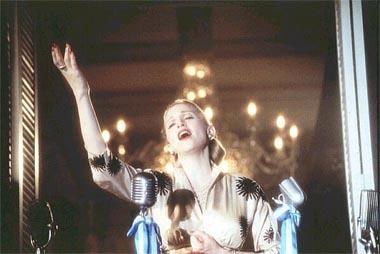 In September, a friend said to me, "You really need to make an effort to see the Gheorgiu Traviata. I played it for my students, and even the ones who never show up cried."
At the time, I had already sort of categorized this star-centric incarnation of Verdi's heartbreaking-est of scores as just that: a sort of novelty event that would be perfectly pleasant, filled with anticipatory buzz, and ultimately leaving one with a small sense of disappointment.
As is often the case, I was truly mistaken.
Despite a rather "sing out Louise!" start, Gheorghiu's Violetta was pretty much out of this world. Light as air, yet full of rich, sexy tones, I found myself thinking "I finally get it. THIS is what a knock-out lyric sporano sounds like live." I know it sounds oversimplified. I think it may not be, really. She is just a damn good singer who is all but perfect in this role.
On a sidenote, I find her to be one of the more amusing divas. There were things about her curtain calls last night that gave me the giggles for the remainder of the evening. She did this sort of hilarious Madonna-on-the-balcony-in Evita thing with her right arm, bent at the elbow at a 90 degree angle, knuckles facing the crowd, followed by enthusiastic waves and eye contact with the Balcony Boxes...as she calmly stood on the stage for an unusually (and delightfully) long time to accept the love. In the last curtain call, Ms. G was the boss. She was leading the cast rather forcefully by the hand about the stage, ensuring each side of the house had their turn to spew glory. And...*ahem*...spew we did.
The love, however, was not reserved for the tragic heroine alone. Jonas Kaufmann's Alfredo was met with -almost- as intense a flood of approval. This, folks, is a good tenor. It is a very grounded, powerful, and remarkably consistent voice that only showed weakness in the highest of registers. As an actor, he brought a fair bit of emotion and hormonal energry to the role, and was well paired with Gheorghiu's appealing doses of high drama.
Anthony Michaels-Moore turns in a very capable Germonthttp://www.blogger.com/img/gl.link.gif. It is a big voice, and despite a few awkward attacks, very listenable.
A successful evening, indeed. I am considering going back for some Dunleavy...or some Hong...maybe even a little D. Croft?
Tuesday, February 07, 2006
Hello there
Our apologies for the lack of action as of late. Something about January-February that makes one remember one's office actually pays one for certain services.
Just wanted to note that Emmeline, Tobias Picker's first opera, has been an enjoyable listen. There's a lot in common with AmTrag--a mezzo singing about God, a factory scene, Pat Racette getting knocked up--but quite an achievement nonetheless. The beauty of Picker is that he always ends up one step ahead of those who would musically dismiss him--of course you can say its Copland regurgitated by Stravinsky or some BS--but goddamn the man writes affecting opera. NOT musical theatre, mind you. I know musical theatre, and this ain't it. But honest to god opera--although he is A) not stuck in the idiom of 1950s academics or B) John Adams. I don't really know what's going to happen here, but it kind of feels like a living breathing opera tradition. That is a neat feeling.
On the Mozart tip, I've been hitting up the 1963 Bohm Cosi. As promised, it's awfully magical. That said, I guess I would quibble with the following: I'm very glad that today's tempi are faster in certain places; Alfredo Kraus sounds extremely nice in some places as Ferrando, but in others he is either sloppy or too heavy; Hanny Steffek's "funny" Despina voice is actually skip the track annoying. That said, the ensemble parts are sublime beyond words, Elisabeth Swarzkopf makes Fiordiligi happen in a way I didn't know possible, and Christa Ludwig's Dorabella is solid as an f'ing rock.
That's all for now. J should currently be watching a certain Miss Gheorghiu expire, so look for more later...
Just wanted to note that Emmeline, Tobias Picker's first opera, has been an enjoyable listen. There's a lot in common with AmTrag--a mezzo singing about God, a factory scene, Pat Racette getting knocked up--but quite an achievement nonetheless. The beauty of Picker is that he always ends up one step ahead of those who would musically dismiss him--of course you can say its Copland regurgitated by Stravinsky or some BS--but goddamn the man writes affecting opera. NOT musical theatre, mind you. I know musical theatre, and this ain't it. But honest to god opera--although he is A) not stuck in the idiom of 1950s academics or B) John Adams. I don't really know what's going to happen here, but it kind of feels like a living breathing opera tradition. That is a neat feeling.
On the Mozart tip, I've been hitting up the 1963 Bohm Cosi. As promised, it's awfully magical. That said, I guess I would quibble with the following: I'm very glad that today's tempi are faster in certain places; Alfredo Kraus sounds extremely nice in some places as Ferrando, but in others he is either sloppy or too heavy; Hanny Steffek's "funny" Despina voice is actually skip the track annoying. That said, the ensemble parts are sublime beyond words, Elisabeth Swarzkopf makes Fiordiligi happen in a way I didn't know possible, and Christa Ludwig's Dorabella is solid as an f'ing rock.
That's all for now. J should currently be watching a certain Miss Gheorghiu expire, so look for more later...
Wednesday, February 01, 2006
Now, With Even MORE Zauber™

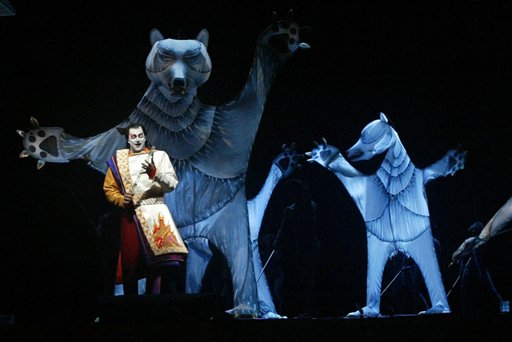
 On the eve of a triple-header this past week of Flute-Flute-Bergerac, I decided the only sane way to manage my opinions would be in one brief follow-up post. And here we are.
 Having missed it last season, I went to Taymor's oh-so-Magic Flute carrying a fairly significant bit of anticipation, and an impressive assortment of preconceptions, both positive and negative. In the end it was, as I expected, totally delightful and over the top. My biggest sentiment afterward, directed in good humor at critics and blogger friends, was something to the effect of "Dear Everyone, Lighten up. Love, Jonathan". I find a lot of humor in people getting so uptight and uncomfortable about a production that is essentially three+ hours of highly imaginative, visually stunning frivolity. It undeniably works with this text and even moreso with Mozart's music. It's just sweet enough, just scary enough, and frankly just senseless enough to perfectly support what is in essence a musically sophisticated vaudeville piece.
And I have to speak to this pervasive argument--the sort of "silver-bullet-no-one-can-argue-this" statement I find so many making about this production: "It distracts from the SINGING" Oh, the singing! Right, right, the singing. God forbid there should be something...ANYTHING to look at while Nathan Gunn inaudibly sings "Der Vogelfänger Bin Ich Ja." I think if anyone NOT insistent on being just a bit above this likeable production actually stepped back for a moment they would realize that it is only "distracting" from the singing when the singing itself is not so hot or, in the case of Gunn and Christy, not so audible. I never for a moment was distracted from Miklosa, Dunleavy, Cutler or Robinson who all turned in very fine if not wholly overwhelming performances (with the possible exception of Robinson, who is about as good a Sarastro as I can recall).
To throw my critical hat in the ring, however, I will say that some of the costumes were retarded. There was a gaggle of choristers at one point that looked like they were in a choir at some sort of Gay Christian Summer Camp in Santa Cruz. If you missed them, they were standing just upstage of the construction paper nuns and just stage left of the felt fingers.
Onward! Last night I had the unexpected pleasure of seeing, and hearing for the first time, Alfano's Cyrano de Bergerac. I gotta admit, I was poised to not like this one. An unpopular cover starring in an obscure opera by a composer known almost solely for his massively edited (thanks Toscanini) last ten minutes or so of Turnadot. At best, I expected to find it a sort of bearable curiosity. Instead, I was delighted to find it a rather lush, emotional piece with two great roles. Unfortunately, Domingo was again "Indisposed" last night ("In the Shower, In the Bathroom"). His cover, Antonio Barasorda, has a sort of unpleasant, wobbly, though not unlistenable voice. I would, however, like to hear the piece with a stronger tenor.
The real star of the evening was Sondra Radvanovsky as Roxane. A particularly savvy opera fan recently turned me on to the wonders of this American soprano. She is sort of that hard to find perfect balance of presence and delicacy--creating a beautiful sound yet never losing full command of the stage. Having only heard her (at least recently) in a couple acts of a ho-hum Die Fledermaus several weeks back, it was nice to see her sing something with significantly more heft, both musically and emotionally.
br> Zambello's production is tasteful and has a sweet, not overly obvious storybook feel to it. I also noticed that the bakery scene in the second act looks remarkably like the set for MARTHA. I did not, however, receive a free Michelin guide, or even a Mario Batali cookbook on the way out.
Afterward, I popped into Tower and picked up a Dialogue des Carmelites recording I have been wanting. It was on sale...I listened to it as I was drifting to sleep last night and woke up to the repeated guillotine *whacks*, which, at 3AM, I found particularly disconcerting.
Subscribe to:
Posts (Atom)