For all the buzz surrounding the late Patrice Chereau's staging of Elektra, premiered two years ago at the Aix-en-Provence festival and now at the Met, there is nothing particularly revolutionary in its concept or presentation (not that there's anything wrong with that). Rather, this production earns its distinctiveness the old-fashioned way, through the accumulation of small choices and thoughtful approaches to well-known story beats.
Visually, it is almost aggressively neutral. A simple courtyard set in pastel washes is only out-blanded by the costumes, seemingly raided from a 1997 Ann Taylor. The lighting design avoids the pervasive gloom of so many Elektra productions, but doesn't substitute anything approaching natural light. This absence of setting appears to be exactly where Chereau wants his characters, a canvas on which to build the engrossing, frequently moving interactions that he creates for them.
Chereau's insistence on an honest dramatic accounting for the relationships between Elektra's characters isn't too much of a departure from the way most directors approach Elektra today. Chereau just takes this idea to its logical conclusion, obsessively stripping out any indulgent vestiges of Elektra as ancient world slugfest.
See, for instance, Chereau's deeply subdued take on the Klytamnestra scene here. Who would believe this much pity for Klytamnestra can be wrung from the score? Waltraud Meier's Queen isn't driven by the usual extravagant paranoid egotism but, pathetic, blinkered self-concern. One kept expecting her to ask Elektra why she doesn't try doing something pretty with her hair for a change.
It's not a choice without consequences, and the scene delivers the thrills which it is usually good for only occasionally. At the cost of fireworks, though, the production buys a valuable insight into Elektra's character. Here the turn on Klytamnestra is devoid of the usual smart aleck glee--Elektra is only capable of vengeance anymore, and lures Klytamnestra into a sadistic emotional trap out of instinct as much as anything. Her lack of pity for Klytamnestra becomes much more than a point on the score board, it becomes a poignant emotional fact about the character.
This sense of wounded humanity permeates the production. The deeply affecting recognition scene presented a stolid, severely non-heroic Orest (Eric Owens), who nonetheless inspires the lingering loyalty of the servants. Upon recognizing her brother, Elektra's first instinct is to escape, the emotions of reunion painful. Her tender words after the recognition are sung to herself, with little illusion that Orest's return represents a chance for her to experience human feeling again.
Likewise the chilling and enigmatic ending. Chereau denies us the usual catharsis of Elektra's feverish dance and surprise death swoon. Here, she attempts a few steps and then retires catatonic to a nearby bench. Orest, his vengeance done but his agony at the hands of the Furies only beginning, just walks away, with no acknowledgment of Elektra or her sister (an intriguing solution to Chrysothemis final cries of "Orest!"). As the orchestra boils over with pent-up fury, the characters are left empty and directionless, a challenging ending, to be sure, but it rings true.
The Met has assembled a formidable cast of singing actors for this production, led by Nina Stemme's tremendous portrayal of the title character. Stemme's coming Ring Cycle in DC has justly been the most hotly pursued of the run. If her middle register can get lost in the orchestra from time to time, it is all forgotten when her voice expands into a full and impressively assured top. "Allein" meandered a bit as she warmed up (not assisted by Salonen's slow tempi) but by Chrysothemis' entrance things had clicked and she delivered a vocal performance of uncommon beauty, consistency, and stamina. The club of Elektras one should get on a plane for is relatively small at any given time, and right now it looks like the membership is her and Goerke.
I've been all up in this recording for the last few weeks, and went into the premiere with Rysanek's obscenely buttery Chrysothemis in my ears, which was maybe not the best choice in hindsight. Adrianne Pieczonka brings a very different sound to Chrysothemis, full-bodied but a bit astringent on top, exciting, but no butter. She wields it with abandon though, and was a committed partner for Stemme, powerfully embodying the production's take on a more canny Chrysothemis, who appears to be no stranger to the abuses of the palace and has perhaps spent a few nights in the yard herself.
As discussed above, the great Waltraud Meier is tasked with the most polarizing interpretation in the show, a subtle and sympathetic Klytamnestra. Anyone who thought this role heralded a confident move into second career shriek-fests for the 'Traud will be sorely disappointed, as she focuses on restrained beautiful singing throughout the part, as well as her expected but ever impressive capacity to bring text to life. There have been complaints about volume which are valid to some degree, though it is hard to disentangle how much of this was a deliberate choice versus some evidence of her current vocal estate.
My most recent memory of Eric Owens was his somewhat thankless turn in WNO's middling Lost in the Stars production, so it was refreshing to see him back in a major league assignment so soon. His emotionally inert Orest was another key choice in this production, and he effectively gave us Orest as angel of death, a tormented man who has returned to his home and family with the sole purpose of murder. Owens' dark baritone makes a strong impression in this role with an uncompromising color that reminds us Orest shouldn't be interchangeable with Jokanaan, but is something grimmer.
Esa-Pekka Salonen, a rare treat at the Met, led a distinctive reading in the pit. As Chereau sought to get inside the personal lives of these bloody archetypes, Salonen lingered over the smaller scenes, abandoning momentum in order to allow character interactions to bloom organically. The finale here had a ferocious transparency and momentum, awesome but almost self-effacing, to the extent that's possible for the end of Elektra.

Sunday, April 24, 2016

Sunday, March 27, 2016
Javier Camarena in DC
I wrote about Javier Camarena's Kennedy Center recital for Parterre.com:
Singers who loom large in the theater have an interesting challenge in translating that intensity to the recital hall. Sometimes we get only fleeting glimpses of that bigger personality amidst tasteful lieder selections; others just import the volume and dramatics wholesale from a bigger space, resulting in performances that can be impressive but overbearing.Read the whole thing here...
Saturday, March 19, 2016
NSO plays Brahms and Beethoven
One of my earliest experiences with the NSO was a concert I attended during the pre-Eschenbach days shortly after I arrived in DC, perhaps the spring of 2009. I went because Brahms was on the program, and, while not necessarily expecting Brahms at the level of what I had just come from in Chicago, was pretty taken aback by what I encountered. Though hardly counting myself as the most critical ear when it comes to orchestral music, it was impossible to miss the out-of-whack balances, tinny sound, and lack of excitement on the stage or in the hall.
I'm happy to say that, 7 years of NSO concert-going later, that evening feels like a distant memory; whatever you may think of Eschenbach, his years in DC have been a boon to the band's overall sound and consistency. However, after hearing both Symphonies 1 and 3 under Eschenbach and the first piano concerto under Osmo Vänskä last night, there is still work to do in the Brahms department.
To be fair, the problems in the first piano concerto were mostly localized in the first movement, that ever ambiguous, halting statement Brahms saw fit for his first orchestral utterance. Conductors must work minor magic to make sense out of its melodic fragments and capriciously shifting colors and Vänskä just never found a firm footing from which he could build momentum with the orchestra. He was not helped by inelegant contributions from the horns and a general lack of commitment coordination in the strings.
Vänskä seemed palpably relieved to move onto the Adagio and elicited some beautiful, very focused, piano sounds from the strings, though perhaps slowing things down to excess at some points. The Rondo was a confident romp, with exciting precision in the exposed passages for the strings, though winds and horns never quite caught up.
Russian Nicolai Lugansky, whom I've never heard before, offered an engaging, measured reading of the solo part. Apparently people refer to him as "cold," most infuriating of all adjectives for a pianist, but his temperament seemed just right for the Brahms, which easily suffers from additional melodrama. See for instance that first entrance, in which the piano answers the orchestra's outsize turmoil with an anemic, meandering little figure. One could easily get caught up in the throes of the anguished orchestra part and ham this up, but Lugansky's reserved introduction was the more unexpected and haunting choice. While clearly possessing the technical chops for flashy virtuosity where needed, Lugansky prioritized intimacy and "Brahms-sized" emotion throughout with appealing results.
I was mildly considering bailing after the Brahms, but was glad I didn't, as Vänskä turned in a winning Beethoven 'Pastoral' Symphony after the half. Vänskä looks to be one of those consummate micromanager conductors, tirelessly trying to tune each dynamic and color as the orchestra hurtles forward, and the NSO seemed to relish the challenge. Vänskä carefully developed the constituent parts of the Allegro, highlighting delicate dynamic gradations and building up a tight transparent sound in the climax. This exacting approach never devolved into preciousness though, and Vänskä was able to pull out a lusty, go-for-broke storm section, and a warm, well-earned Allegretto.
I'm happy to say that, 7 years of NSO concert-going later, that evening feels like a distant memory; whatever you may think of Eschenbach, his years in DC have been a boon to the band's overall sound and consistency. However, after hearing both Symphonies 1 and 3 under Eschenbach and the first piano concerto under Osmo Vänskä last night, there is still work to do in the Brahms department.
To be fair, the problems in the first piano concerto were mostly localized in the first movement, that ever ambiguous, halting statement Brahms saw fit for his first orchestral utterance. Conductors must work minor magic to make sense out of its melodic fragments and capriciously shifting colors and Vänskä just never found a firm footing from which he could build momentum with the orchestra. He was not helped by inelegant contributions from the horns and a general lack of commitment coordination in the strings.
Vänskä seemed palpably relieved to move onto the Adagio and elicited some beautiful, very focused, piano sounds from the strings, though perhaps slowing things down to excess at some points. The Rondo was a confident romp, with exciting precision in the exposed passages for the strings, though winds and horns never quite caught up.
Russian Nicolai Lugansky, whom I've never heard before, offered an engaging, measured reading of the solo part. Apparently people refer to him as "cold," most infuriating of all adjectives for a pianist, but his temperament seemed just right for the Brahms, which easily suffers from additional melodrama. See for instance that first entrance, in which the piano answers the orchestra's outsize turmoil with an anemic, meandering little figure. One could easily get caught up in the throes of the anguished orchestra part and ham this up, but Lugansky's reserved introduction was the more unexpected and haunting choice. While clearly possessing the technical chops for flashy virtuosity where needed, Lugansky prioritized intimacy and "Brahms-sized" emotion throughout with appealing results.
I was mildly considering bailing after the Brahms, but was glad I didn't, as Vänskä turned in a winning Beethoven 'Pastoral' Symphony after the half. Vänskä looks to be one of those consummate micromanager conductors, tirelessly trying to tune each dynamic and color as the orchestra hurtles forward, and the NSO seemed to relish the challenge. Vänskä carefully developed the constituent parts of the Allegro, highlighting delicate dynamic gradations and building up a tight transparent sound in the climax. This exacting approach never devolved into preciousness though, and Vänskä was able to pull out a lusty, go-for-broke storm section, and a warm, well-earned Allegretto.
Friday, March 11, 2016
NSO plays Picker, Liszt, Brahms
 |
| 16th Street and Columbia Rd, Washington. |
The balance of the first half was devoted to Liszt's second piano concerto, featuring Jean-Yves Thibaudet. Eschenbach presided over an exciting, very severe allegro agitato, followed by a dreamy allegro moderato with beautiful interplay between Thibaudet and principal cellist David Hardy. The penultimate Marziale is Liszt in trashy exuberance mode, and Eschenbach pushed things perhaps too far--frequently drowning out Thibaudet and precipitating at least one orchestra snarl. Things tightened up for an appropriately breakneck finale.
The NSO has been playing Brahms First Symphony a lot the past few weeks as part of their tour repertoire, heard at home in an erratic performance during one of the tour tryout evenings. Tonight they gave Brahms 3rd in a more assured take. Eschenbach has the right feel for the sturm and drang of the first movement, conjuring relentless anxiety and big satisfying swells from the orchestra, though the strings weren't always able to maintain coherence and beauty amidst all the agitation. Eschenbach relished the languid pace of the second and third movements, taking things maybe a bit slow for some tastes but I appreciated his patience in letting the quiet details in these passages unfold at their own pace.
The anguished fourth was a (mostly) controlled whirlwind, at its best achieving an exhilarating momentum and thrilling unified sound. Despite two weeks on the road together, though, the orchestra and Eschenbach seemed at cross purposes at several points, with several seemingly unanticipated gear shifts leaving the band in disarray. It's hard to go wrong with the 3rd's devastating, unexpectedly quiet coda, and this one mostly satisfied, though never quite reaching that hushed stasis that makes for such a chilling contrast with what has come before.
In a bizarre programming choice, the NSO then tacked on Hungarian Dances #3, #10, and #16, for a combined 7 or so minutes of bonus music. It's unclear whether someone felt the 3rd didn't make for a long enough second half (though it was already past 9 after a 7 PM start), that the end of the 3rd was too much of a bummer to end a show with, or whether some obscure union rules were in play, but none of the players seemed in the mood for these bonbons after the emotional catharsis of the 3rd. Odd.
Wednesday, March 09, 2016
WNO Announces
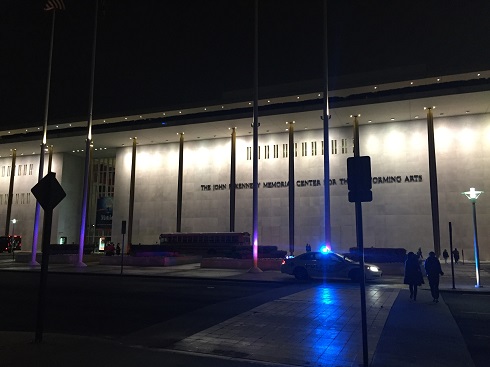 |
| Kennedy Center, Washington. |
You can't quite blame a company for taking the proverbial cigarette break after serving up a big historic Ring cycle, and WNO's 2016-2017 line-up is definitely a less ambitious affair than the current season, though redeemed in part by attractive casting and an admirable focus on contemporary work.
We get two chestnuts to bookend the season, Marriage of Figaro and Butterfly, both of which WNO hasn't done since 2010-11. Figaro gets opening night, in a production "adapted" from this nondescript-looking Glimmerglass effort from a few years back. Casting keeps this one interesting, with two intriguing WNO debuts: Amanda Majeski's Countess and Lisette Oropesa as Susanna. Oropesa made a fine impression here several years back with Washington Concert Opera in Verdi rarity I Masnadieri but she is long overdue for time on the mainstage.

Butterfly closes the season out, in a production imported from SFO (as was the tasteful 2010 incarnation). This time, the production is designed by Jun Kaneko, responsible for the video-projection driven/primary color-laden Floot the other year; we'll see whether that's a good look for Butterfly. The lead is shared between one unknown and one very well known quantity: Albanian Ermonela Jaho, of whom I am completely ignorant, and longtime Met veteran Hei-Kyung Hong. Peenk-air-ton offers a contrast as well, with Brian Jagde's big hearty sound swapping nights with Dimitri Pittas' light elegant tenor. Auguin conducts.
Fille du Regiment fills the wild card Donizetti fluff slot--an opera seen at WNO only once before in the 06/07 season. WNO has procured a first-rate A-cast here, with Oropesa back again and Lawrence Brownlee taking the role of Tonio.
The most distinctive programming is reserved for two American works, representing WNO's contribution to the JFK centennial that is being used to unify a lot of activities across the KC next year: Jake Heggie's popular "Dead Man Walking" and "Champion" by jazz musician Terence Blanchard. WNO seems to be economizing to get two contemporary productions onstage, as the press release notes these shows will use "many of the same designers and scenic elements." Kate Lindsey, assuming the role of Sister Helen Prejean, is the standout casting here.
I was lukewarm on Heggie's Moby Dick but am excited for DMW, and certainly support WNO's efforts to highlight the most successful American works out there. As for "Champion," I'm not familiar with Blanchard's music, but props to WNO for foregoing a musical offering this year in favor of a second contemporary work. Rounding out the contemporary offerings will be the company's regular evening of 20 minute new works and an hour-long premiere by Mohammad Fairouz.
Will try to circle back to other aspects of the new season later this week...
Tuesday, February 16, 2016
"Lost in the Stars" at WNO
I wrote about WNO's "Lost in the Stars" production for Parterre:
Kurt Weill and Maxwell Anderson’s 1949 musicalization of Alan Paton’s Cry, the Beloved Country has found a tentative home on the opera stage, attractive to companies eager to fill their musical slot(s) for its highbrow pedigree, star vehicle potential, and relevant political content. Washington National Opera is the latest to try their hand at Lost in the Stars, but despite a strong cast and sympathetic direction, this latest incarnation isn’t able to overcome the flaws of this intriguing but problematic work.Read the whole thing here...
Tuesday, February 09, 2016
Met Council Finals Mid Atlantic Region

Sunday's Met Council Mid-Atlantic finals were dominated by a group of exceptional bass/baritones, with all but one of those competing walking away with a prize. In an afternoon brimming with talent, the low voices set themselves apart with polished, distinctive voices, and natural dramatic flair.
Anthony Schneider, a first place winner who will continue on to semifinals in New York, brings to the table a unique, resonant sound, well represented in Il lacerato spirito from Simon Boccanegra, and demonstrated agility and personality in "Quand la flamme de l'amour" from Bizet's La Jolie Fille de Perth. His co-first place finalist, tenor Jonas Hacker, first offered Una Furtiva Lagrima, demonstrating formidable control in a series of impeccably executed dynamic effects, though his voice lacked that final touch of warmth needed for this music. The judges wisely chose "Here I stand" from Rake's Progress as a second aria, and there were no qualifications here--Hacker's incisive power and facility with text seems a natural fit for exciting Britten and other 20th century fare.
Second place went to bass Timothy Bruno, a current young WNO young artist this season, who has participated in the various young artist-staffed new work presentations. Bruno's pitch-black sound is distinctive for sure, though it was a perhaps a heavier color than one wants in his first aria, "Solche hergelaufne Laffen" from Mozart's Entfuhrung. Another round of Boccanegra fared better, with Bruno producing a very exciting second helping of "Il lacerato spirito."
Third place was also a tie. Baritone Andrew Lovato was perhaps my personal favorite among the considerable bass-baritone talent on display. "Ya va Lyublyu" from Pique Dame was devastating, Lovato carefully shading his voice to great effect throughout the work. The Tanzlied from Die Tote Stadt was a fun second choice, and a great chance to show off the capabilities of perhaps the most refined low-voice onstage, though it would have benefited from more subtlety.
He shared honors with baritone Armando Pina, who turned in a winning, if slightly generic, sound. His lead-off "Ya vas lyublyu" couldn't quite compete with the detailed pathos of Lovato's account but was nonetheless an impressive assumption. "Hai gia vinta la causa" was similarly sturdy.
Mezzo Briana Hunter was perhaps a surprising omission from the winners circle. In "Elle et la, pres de lui" from Thomas' Mignon, she showed off an ample, compelling sound, only marred by a bit of inconsistency in the high notes, some of which sounded great, while others felt a tad uncomfortable. Her follow-up, "Una voce poco fa," represented the most accomplished coloratura singing of the afternoon, and demonstrated a winning stage personality. Soprano Raquel Gonzalez also stood out among the women, with a sophisticated, smoky sound in "Come in quest'ora bruna" and "Stridono lassu" from Pagilacci.
Thursday, February 04, 2016
NSO plays Brahms, etc.

A few belated words on the NSO show last Saturday. This was the second of two weekends led by Eschenbach, his first appearances since the announcement that Gianandrea Noseda will succeed him at the NSO's helm. The program featured the second group of works that the NSO will take on tour to Europe this month--the overture to Der Freischutz, Schubert's Symphony No. 8, and Brahms First Symphony.
Anne Midgette rightly questions what the deal is with going all the way to Europe to play a bunch of Central European Top 40 hitz to the locals. Except for a contemporary work by Christopher Rouse this is the reddest of red meat programming. Do European promoters expect American orchestras to prove they can hack it? Sort of the opposite of how we expect Czech orchestras and conductors do the Prague Symphony and Dvorak all the time?
Anyhow, the first half Schubert and Weber were fine, but I was in it for the Brahms. Eschenbach came out swinging, highly attuned to the rollicking push and pull of the first movement and its restless lurching between meters. This was full blooded but tightly controlled Brahms that wasn't shy about playing up the fundamentally unpleasant nature of Brahms' first official statement in symphonic form. The second movement, with its balance of repression and release, benefits from a slow burn and holding something back, but Eschenbach took the bait and went back to the generic emotional swell too often. Things went downright haywire in the final bars which slow to a point of stasis, such that Nurit Bar-Josef's violin solo seemed oddly rushed and cursory, perhaps a tempo miscommunication issue? The allegretto was fairly scattered as well, with shifts in tempi that had the orchestra stumbling over itself at times. Thankfully Eschenbach was back in form for the closing movement, and led a truly exhilarating rush to the finale.
It sounds like Friday's run was much tighter, so perhaps an off-night or just trying some stuff here before heading out on the road...
Wednesday, February 03, 2016
David Daniels Sings Brahms, Hahn, and Purcell
I wrote about David Daniels recital for Vocal Arts DC last weekend for Parterre:
Washingtonians enjoyed a happy reunion this past Sunday with David Daniels, a lucky substitution for the originally scheduled Alexander Tsymbalyuk on the Vocal Arts DC calendar. Daniels isn’t exactly a regular on DC stages—he last graced the opera house in 2008 opposite Placido Domingo in Handel’s Tamerlano (a rare Baroque foray for WNO)—but contributing to Ruth Bader Ginsburg lore will get you everywhere with this crowd.Read the whole thing here...
Wednesday, January 27, 2016
Met On Demand: Damnation of Faust

First time I had seen this production, which I narrowly missed in house back in 2008. Robert LePage's video driven production of Berlioz' oratorio was a big hit at the time, soon to be remembered as the "good" LePage production after opinion polarized over the first installment of his Ring. (Though Tommasini dropped some good shade at the time: "To judge from the rousing ovation Mr. Lepage received, this innovative production looks to be a popular success...")
No doubt this is a more effective, immersive use of video than the subsequent Ring productions, which suffered from the fundamentally off-putting Machine set and a mismatch with the pace and dramatic constraints of the Ring. Berlioz' fantastical meditation on the Faust myth, never intended for the stage, makes much more sense as a purely sensual experience, and a perfect fit for the possibilities of LePage's visual approach.
All that said, and admitting the difficulty of judging this kind of production on video, I was surprised at how frequently I found myself blaming the effects for the difficulty the work had grounding itself and gathering any momentum. While succeeding with a more unified aesthetic approach to the video aspects, LePage hasn't figured out what makes dramatic sense here any better than the Ring. Too often the production drives you to distraction rather than enhancing your experience of Berlioz' work.
The work is a feast for orchestra and chorus, and the Met's crack forces, led by Levine, make this a memorable production even before the soloists are taken into account. Love the hell chorus section where the civilians of the Met chorus, no buff supernumeraries in sight, have to take off their shirts and sing about demons with mean looks on their faces for (what feels like) 20 minutes. Great chorus work and a weirdly unsettling piece of stagecraft.
Giordani sounds great in Faust's music, delivering the delightfully predictable old school vocal swagger that gets him the big bucks, though his acting chops are a shade blander than his colleagues when subjected to closeup HD. He keeps it together for most of the show, though when the going gets more strenuous he noticeably straddles the line between effortful-but-legit and wait-I-don't-think-this-sounds-good-anymore territory.
This is a sweet-spot role for Graham and she proves again why she is the consummate Live in HD professional, sounding great and hitting all her marks as Marguerite (note how long she holds her beatific face as she has to climb a ladder all the way to the rafters facing camera at the end). "Professional" of course can cut two ways, and if you have trouble getting excited about her, this will not change your mind.
John Relyea, still the man to beat when it comes to 19th century devil characters, frequently threatens to steal the show with his codpiece and the unflagging silky-manly sound he serves up for Berlioz' Mephistopheles.
Friday, January 22, 2016
Musicians from Marlboro play Beethoven, Penderecki and Brahms

Cover of first edition of Brahms piano quintet, with four hand piano arrangement.
Amidst some nasty pre-snowmageddon precipitation, musicians from the Marlboro Festival served up the first of their two off-season tour shows at the Library of Congress Wednesday evening, injecting a bit of that gentle Vermont summer into crappy mid-Atlantic January.
Having made it to Marlboro the last two summers, I will disclose that I have fully drunk whatever the audience version of the Marlboro Kool-aid is. Whether it is the time that participants are able to lavish on a single work, the sense of camraderie, or the bucolic setting, there is something very special about Marlboro performances (obligatory link to Alex Ross' article from a few years back). Time and again one finds a depth in precision, blend, and articulation that ensures these performances are never boring, and it is enough to keep audiences (and musicians) traveling back to the country to get another hit of that sweet sweet chamber music drug. Happily, the stuff they export shares many of these winning qualities, too.
Beethoven's String Trio in C-minor, op. 9, featured the gorgeous blend of violinist David McCarroll, violist Daniel Kim, and cellist Marcy Rosen, in a reading both aurally decadent and musically engrossing. The first half also included Kryzysztof Penderecki's 1993 quartet for clarinet and string trio, adding the violin of Emilie-Anne Gendron, and Anthony McGill, principal clarinet of the New York Philharmonic. This fascinating piece covers huge thematic and emotional ground in its brief running time, and the quartet brought out moments of tremendous beauty (Gendron's solo in the closing Larghetto) as well as controlled frenzy in the second movement.
The second half featured a bit of unabashed luxury programming in Brahms' late Clarinet Quintet, famously composed near the end of his life after he had considered giving up composing. His collaboration with the clarinettist Richard Muhlfeld stayed his retirement and produced some of the most beloved works in his entire output and enduring pinnacles of the literature for the instrument. I will also note that this past summer in Vermont, I heard Rosen lead a performance of the Brahms String Quintet in F Major that immediately ranked in my top Brahms encounters of all time, so needless to say, this was an exciting prospect.
The Marlboro crew turned in a furious first movement, reaching for blistering fortes that immediately belied the "autumnal" modifier usually applied to this work. If things got a bit aggressive at times (and McGill occasionally seemed overextended trying to compete with the strings), the choice made sense in the striking contrasts with those moments where the movement slows to catch its breath. The Adagio offers the most intimate and individual writing for the clarinet, and McGill provided a solo of overwhelming beauty and quiet touches of personality. The interplay here between solo and strings, the epic push and pull of emotional tension, all unfolded with irresistible vitality. After a gentle Andantino, the group delivered a moving closing Con Moto, by turns yearning and ambivalent, a palpable chill descending with the arrival of the final dark figures in the strings.
Monday, January 18, 2016
NSO plays Eller, Prokofiev, and Sibelius
Esteemed Estonian conductor Neeme Jarvi took the NSO's helm this past weekend in the first subscription concert since the announcement of music director designate Gianandrea Noseda (and the bittersweet end of conductor roulette). Thursday's show opened with "Five Short Pieces for Orchestra" an attractive mid-century work by Heino Eller, an Estonian composer championed by Jarvi, which offered a compelling showcase for the NSO strings.
The highlight of the evening was Prokofiev's first Violin Concerto, featuring a mesmerizing performance by Latvian violinist Baiba Skride. Skride and Jarvi created fine tension in a restrained, inward facing first movement, bringing the audience in close to catch the hushed solo. Skride then abruptly shifted gears for the raucous second movement, skillfully highlighting Prokofiev's biting sarcasm and giving free rein to harsh earthy sounds in the blistering passage work. When the third movement finally turns to indulgence, Skride delivered a pure, beguiling sound for the doomed cocktail music of the finale.
After the half, Jarvi opened with a raw reading of the first movement of Sibelius' Symphony #2, heightening the contrasts between the scattered motivic fragments that run into and over each other and eliciting some especially fine piano dynamics from the orchestra. A heavy hand in the grim second movement was perhaps too much at times, and the plodding tempo might have been partially responsible for some muddy sounds in the brass. Thankfully things snapped back into place for a precise scherzo and exquisite solos for oboe and clarinet, capped with an appropriately irresistible climax leading into the Finale. Here and there transitions felt overly generic and on-the-nose, but overall Jarvi brought the work to an exhilarating close.
Wednesday, January 13, 2016
Better Gods at WNO
I wrote about WNO's new hour long work Better Gods for Parterre:
The arrival of winter in DC heralds a long fallow period for Washington National Opera’s mainstage offerings, as the Opera House is turned over to the Kennedy Center Honors and extended sit downs for traveling musicals. But WNO is staying busy, and while Aretha Franklin and Matilda cavort downstairs, the company continues to present new work up in the Terrace Theatre under its American Opera Initiative banner.Read the whole thing here...
Sunday, December 06, 2015
NSO plays Adams, Barber, Copland, etc.
Caught an eclectic program of American composers from the NSO Saturday, led by the American conductor Sarah Hicks. John Adams' "The Chairman Dances," which predates Nixon in China but points to many of the familiar themes from the opera's third act, made for a strong opening. If the strings sounded frayed at times Hicks and the NSO captured the propulsive momentum and whiplash shifts that make the work tick.
Organist Cameron Carpenter then joined the band for Samuel Barber's towering 1960 Toccata Festiva. Carpenter's solo captivated in both the sensitive moments as well as the bravura pedal playing, accented by rhinestone-heeled organ boots. Carpenter wrapped up with an improvisation on Americana themes plus an encore improvisation incorporating the Beatles' Imagine tune. If the overall impression was slight, Carpenter kept things concise and its no small thrill to watch him work the stops.
The second half opened with a fine showpiece for orchestra, the rarely heard 1954 Danse Overture of Italian-American composer Paul Creston, teamed nicely with an ebullient reading of Copland's 1938 suite from his ballet Billy the Kid.
In between, we got a new work by Mason Bates, now Kennedy Center composer in residence, which melds orchestra music with...techno beatz. I can certainly appreciate why this sort of thing is catnip to the people tasked with writing sexy press releases about the orchestra but in practice it is pretty dreadful. I'd rather not go full curmudgeon on this, but everything from the amplification to the overbearing sense of trying too hard was deafening. This stuff kind of appeals in the way a hip movie soundtrack does, but as compelling concert music? Noap. Misfires aside, NSO deserves significant credit for the thoughtful programming...
Organist Cameron Carpenter then joined the band for Samuel Barber's towering 1960 Toccata Festiva. Carpenter's solo captivated in both the sensitive moments as well as the bravura pedal playing, accented by rhinestone-heeled organ boots. Carpenter wrapped up with an improvisation on Americana themes plus an encore improvisation incorporating the Beatles' Imagine tune. If the overall impression was slight, Carpenter kept things concise and its no small thrill to watch him work the stops.
The second half opened with a fine showpiece for orchestra, the rarely heard 1954 Danse Overture of Italian-American composer Paul Creston, teamed nicely with an ebullient reading of Copland's 1938 suite from his ballet Billy the Kid.
In between, we got a new work by Mason Bates, now Kennedy Center composer in residence, which melds orchestra music with...techno beatz. I can certainly appreciate why this sort of thing is catnip to the people tasked with writing sexy press releases about the orchestra but in practice it is pretty dreadful. I'd rather not go full curmudgeon on this, but everything from the amplification to the overbearing sense of trying too hard was deafening. This stuff kind of appeals in the way a hip movie soundtrack does, but as compelling concert music? Noap. Misfires aside, NSO deserves significant credit for the thoughtful programming...
Friday, December 04, 2015
American Opera Initiative at WNO
I wrote about the WNO's evening of new works for Parterre...
Washington National Opera presented the fourth annual installment of its “American Opera Initiative” series in the Kennedy Center Terrace Theater Wednesday evening, a welcome opportunity to sample new work in appealing bite-sized chunks.Read the whole thing here...and here's coverage from Charles Downey and Anne Midgette.
Monday, November 16, 2015
Appomattox at WNO
I wrote about the new production of Phillip Glass's Appomattox at WNO for Parterre Box:
Read the whole thing here.
Saturday’s Washington National Opera premiere of a new version of Philip Glass and Christopher Hampton’s opera Appomattox had everything going for it: the long-overdue appearance of the work of America’s greatest living opera composer on a Kennedy Center stage, timely and important subject matter tied to recent historical milestones, even a sexy policy hook (that’s a thing). Everything, as they say, but the opera...
Read the whole thing here.
Thursday, November 05, 2015
Bach Collegium Japan at LOC
Got to see Bach Collegium Japan for the first time at the Library of Congress last night, in a seemingly rare DC appearance. There's a certain electricity generated by the major league period bands, an expectation that you're going to hear something entirely new that you're unlikely to hear again, and Masaaki Suzuki and his forces delivered in memorable fashion in a program of Bach, Vivaldi and Handel.
The Collegium anchored the evening with Brandenburg Concerto No. 2, an exciting taste of the period brass and wind delights to come. The highlight here was trumpeter Guy Ferber playing a coiled baroque trumpet that cooperated only intermittently, but when it did produced a unique gentle tone that blended beautifully with the buzzy, cacophonous sound of the band. Idle googling of baroque trumpets this morning (as one does) turned up this Nikolaus Harnoncourt quote which sums up the appeal quite nicely: "Bach wrote a concerto [2nd Brandenburg] for four different but equal instruments: trumpet, recorder, oboe, violin. The art was to create a dialogue among these four instruments, and this is obviously only possible when the trumpet plays as softly as the recorder and the recorder as loud as the trumpet."
The meat of the program was dominated by two Vivaldi concertos for solo winds. The first, the Concerto in C major for recorder, strings and continuo (RV 443) featured what can only be described as a completely gonzo recorder solo played by Andreas Bohlen that inspired a raucous mid-half standing ovation. The second, the Oboe Concerto in C major (RV 450), presented Masamitsu San'nomiya in a dizzy, elegant oboe solo that showcased the great expressive possibilities of the instrument. Rounding out the wind offerings, was something a bit less flashy, Bach's Sonata for flute in E minor (BWV 1034), with soloist Kiyomi Suga on the traverso flute. The mellow sound of the wooden flute was welcome for a non-flute enthusiast and Suga delivered long, sighing phrases in the third movement.
After the Branderburg, the Collegium's biggest forces were assembled for two works with soprano Joanna Lunn. The second, Bach cantata "Jauchzet Gott in allen Landen!" (BWV 51) was the biggest attraction, featuring Ferber on spinning out long trills on another baroque trumpet, and a series of energetic tempi. The first, a recently discovered and disputed setting of the Gloria attributed to Handel, wasn't terribly distinctive but included some sparkling passagework. Lunn had her work cut out for her in carrying these pieces and did yeoman's work throughout, though hampered a bit by that soprano volume knob thing--a bright, very loud (though nice sounding!) top that jarringly alternated with a more anemic middle register.
The Collegium anchored the evening with Brandenburg Concerto No. 2, an exciting taste of the period brass and wind delights to come. The highlight here was trumpeter Guy Ferber playing a coiled baroque trumpet that cooperated only intermittently, but when it did produced a unique gentle tone that blended beautifully with the buzzy, cacophonous sound of the band. Idle googling of baroque trumpets this morning (as one does) turned up this Nikolaus Harnoncourt quote which sums up the appeal quite nicely: "Bach wrote a concerto [2nd Brandenburg] for four different but equal instruments: trumpet, recorder, oboe, violin. The art was to create a dialogue among these four instruments, and this is obviously only possible when the trumpet plays as softly as the recorder and the recorder as loud as the trumpet."
The meat of the program was dominated by two Vivaldi concertos for solo winds. The first, the Concerto in C major for recorder, strings and continuo (RV 443) featured what can only be described as a completely gonzo recorder solo played by Andreas Bohlen that inspired a raucous mid-half standing ovation. The second, the Oboe Concerto in C major (RV 450), presented Masamitsu San'nomiya in a dizzy, elegant oboe solo that showcased the great expressive possibilities of the instrument. Rounding out the wind offerings, was something a bit less flashy, Bach's Sonata for flute in E minor (BWV 1034), with soloist Kiyomi Suga on the traverso flute. The mellow sound of the wooden flute was welcome for a non-flute enthusiast and Suga delivered long, sighing phrases in the third movement.
After the Branderburg, the Collegium's biggest forces were assembled for two works with soprano Joanna Lunn. The second, Bach cantata "Jauchzet Gott in allen Landen!" (BWV 51) was the biggest attraction, featuring Ferber on spinning out long trills on another baroque trumpet, and a series of energetic tempi. The first, a recently discovered and disputed setting of the Gloria attributed to Handel, wasn't terribly distinctive but included some sparkling passagework. Lunn had her work cut out for her in carrying these pieces and did yeoman's work throughout, though hampered a bit by that soprano volume knob thing--a bright, very loud (though nice sounding!) top that jarringly alternated with a more anemic middle register.
Kissin plays Beethoven, Brahms, Albeniz
I procrastinated writing about that nice Kissin recital last week, so I'm afraid he gets the bullet point treatment:
- Not really sure what I'm looking for from Mozart in recital these days but Kissin's opener, the Piano Sonata No. 10, didn't quite have it. At times it feels like Mozart is not a great fit for Kissin's gifts, as if he is working over time to inject character into the piece, only really connecting where the Sonata takes a darker, more expansive tone.
- The Appassionata was monumental, staggering--a rendition to easily best any in recent memory and people program it a whole lot in DC. Kissin doesn't just want to give you an exciting take, he wants you to hear the symphony orchestra thrashing around in the piano as Beethoven surely heard it, and he has the technical gifts and commitment to deliver.
- Was very glad to see three Brahms Intermezzi programmed (Op. 117), which found Kissin in a somewhat subdued mode after intermission. The first was maybe a bit ponderous, but he found wonderful colors in the second and third rounding out the set.
- The real revelation in the second half were four pieces of Isaac Albeniz. Perhaps not repertoire we're used to hearing from him but they were handled beautifully, Kissin bringing out gorgeous singing melodies while imbuing even smaller details, like the rippling water figure in the first piece, with trademark polish.
- The first two encores offered more opportunities to hear his skills with Spanish composers in two pieces of Granados, plus a suitably rousing Brahms' Hungarian dance No. 1.
Wednesday, October 21, 2015
Lucia di Lammermoor at SFO
Unexpectedly found myself in San Francisco last Friday and caught the current Lucia production from standing room at the War Memorial Opera House, which FWIW, is quite pleasant. The standing section may not have the velvet armrests of the Met, but it's only one row deep, and each side has its own little dedicated supertitle screen. It's also far preferable to paying hefty sums for the back of the distant War Memorial OH balcony and enduring the indignity of those jumbo-trons.
Nadine Sierra, the young American soprano filling in for Diana Damrau in this production (though they are still handing out Damrau flyers in the lobby...totally awkward, guys) certainly proved she can hold her own in this demanding role. Its a very pretty, pure sound with the right delicacy needed for Lucia and the coloratura moments, especially the mad scene, were all very solid and appropriately intoxicating. If today she perhaps lacks that extra bit of panache/swagger that makes for a really memorable assumption, she has quite the formidable foundation to build on and deepen in the role. She also felt a bit under-powered in the ensembles, grasping a bit for a sustained line to cut through the thick of the orchestra and the rest of the crowd, though she apparently had some indisposedness going on that evening, which may have contributed.
Piotr Beczala's Edgardo was a welcome chance to hear him, though it was hard not to feel at times that he was shoehorning the very wonderful things he does into a role that doesn't quite fit. While his golden middle range always seduces, he tends to run out of ping at the top--hardly a dealbreaker in Verdi or something, but that flood of bel canto dopamine that doesn't require too much thinking is kind of the whole deal with Edgardo. Beczala also has a tendency to phrase with a sort of impatient declamation, which, at the volume he can deliver, is certainly very exciting. So exciting one forgets sometimes that you're missing the long-lined phrasing needed in this music.
Perhaps the strongest link in a pretty strong cast was the Enrico of Brian Mulligan, which shouldn't have been a surprise for me at all, since apparently I enjoyed him in the same part at WNO just a few years ago. Well, mea culpa for not getting it at the time, but Mulligan's sound is incredibly special, a rich, resonant baritone that tackles the expressiveness and the legato of the role as though no one's told him he isn't a tenor. Please come back to WNO soon we promise we won't take you for granted this time. Of the rest of the principals, Nicolas Teste's commanding Raimondo also deserves a shout out.
Appreciated the chance to get to hear Luisotti conduct, who had a great idiomatic feel for the catchy little figures that pepper the score. The production was...fine. Basically one of those why-even-bother updatings that could have easily time-traveled from NYCO circa 2002 (minus the slick video-projections). Its chief effect was to make me feel better that SFO is just as good at turning out a nondescript stinker as the local team (my last SFO visit was for that gorgeously stylish Mattila Makropolous production). Random points--fun "in the near future" gowns in the wedding party crowd scene; drawing in the stage side panels to "frame" Lucia's Act 1 garden scene arias felt like watching it being filmed on your iphone held the wrong way; and, if Scotland degenerates into some kind of clan-based fascism in "the near future" are they really going to do a National Socialism throwback thing? Really? Whatever. Like I said, fine.
Nadine Sierra, the young American soprano filling in for Diana Damrau in this production (though they are still handing out Damrau flyers in the lobby...totally awkward, guys) certainly proved she can hold her own in this demanding role. Its a very pretty, pure sound with the right delicacy needed for Lucia and the coloratura moments, especially the mad scene, were all very solid and appropriately intoxicating. If today she perhaps lacks that extra bit of panache/swagger that makes for a really memorable assumption, she has quite the formidable foundation to build on and deepen in the role. She also felt a bit under-powered in the ensembles, grasping a bit for a sustained line to cut through the thick of the orchestra and the rest of the crowd, though she apparently had some indisposedness going on that evening, which may have contributed.
Piotr Beczala's Edgardo was a welcome chance to hear him, though it was hard not to feel at times that he was shoehorning the very wonderful things he does into a role that doesn't quite fit. While his golden middle range always seduces, he tends to run out of ping at the top--hardly a dealbreaker in Verdi or something, but that flood of bel canto dopamine that doesn't require too much thinking is kind of the whole deal with Edgardo. Beczala also has a tendency to phrase with a sort of impatient declamation, which, at the volume he can deliver, is certainly very exciting. So exciting one forgets sometimes that you're missing the long-lined phrasing needed in this music.
Perhaps the strongest link in a pretty strong cast was the Enrico of Brian Mulligan, which shouldn't have been a surprise for me at all, since apparently I enjoyed him in the same part at WNO just a few years ago. Well, mea culpa for not getting it at the time, but Mulligan's sound is incredibly special, a rich, resonant baritone that tackles the expressiveness and the legato of the role as though no one's told him he isn't a tenor. Please come back to WNO soon we promise we won't take you for granted this time. Of the rest of the principals, Nicolas Teste's commanding Raimondo also deserves a shout out.
Appreciated the chance to get to hear Luisotti conduct, who had a great idiomatic feel for the catchy little figures that pepper the score. The production was...fine. Basically one of those why-even-bother updatings that could have easily time-traveled from NYCO circa 2002 (minus the slick video-projections). Its chief effect was to make me feel better that SFO is just as good at turning out a nondescript stinker as the local team (my last SFO visit was for that gorgeously stylish Mattila Makropolous production). Random points--fun "in the near future" gowns in the wedding party crowd scene; drawing in the stage side panels to "frame" Lucia's Act 1 garden scene arias felt like watching it being filmed on your iphone held the wrong way; and, if Scotland degenerates into some kind of clan-based fascism in "the near future" are they really going to do a National Socialism throwback thing? Really? Whatever. Like I said, fine.
Tuesday, October 06, 2015
Rienzi with the National Philharmonic
I was hoping the National Philharmonic's presentation of Wagner's Rienzi this past Saturday would have signaled the end of my Rienzi virginity, but due to circumstances beyond my control I was only able to see the second half. Add to this the fact that the deeply (and wisely) cut score for this concert staging basically constituted a highlights show, and, well, I think I can only claim second base.
Rienzi is perhaps best understood as what would happen if you took Tannhauser and subjected it to the Hollywood producers that give notes on stuff like Fast and Furious 7. There are really a huge variety of interesting musical ideas, and lots of delightfully recognizable Wagnerisms, but any breathing room in the drama has been rigorously excised in favor of nonstop grand opera thrill ride action, an event-heavy plot, and stock characters that leave little to the imagination.
But music certainly worth hearing, especially with the compelling forces marshaled by National Philharmonic chief Piotr Gajewski. The big draw of the evening was Issachah Savage in the title role, who I think its fair to call a DMV favorite, but has also recently appeared in things like the Goerke Toronto Walkures last year. His big irresistible tenor fits beautifully in the Lohengrin/Walther/etc Wagner parts, with enough heft to impress but still sweet and ringing throughout. Rienzi's big 11 o'clock number in the Fifth Act, which recalls the familiar motif of the overture was a gorgeous showcase for his sound and was met with appropriately thunderous applause. Here's his Mein Lieber Schwan. Oh and a little big of his great sounding Bacchus here. You know you want more.
Also notable were Rienzi's ladies--Mary Ann Stewart gave a passionate account of heldentrouseren role Adriano, while Eudora Brown impressed as Rienzi's sister, Irene. They cut that slightly creepy "Shades of Walsungen" scene in the Fifth Act with Rienzi (again, wisely), so by missing the first half I probably missed a lot of the Irene stuff that remained, but thankfully got to hear her soaring contributions in the latter half ensembles. Gajewski led a rollicking account from the Philharmonic and assembled choral forces, delivering what can only be called a crowd-pleaser--something I'll wager Rienzi is not often accused of.
Rienzi is perhaps best understood as what would happen if you took Tannhauser and subjected it to the Hollywood producers that give notes on stuff like Fast and Furious 7. There are really a huge variety of interesting musical ideas, and lots of delightfully recognizable Wagnerisms, but any breathing room in the drama has been rigorously excised in favor of nonstop grand opera thrill ride action, an event-heavy plot, and stock characters that leave little to the imagination.
But music certainly worth hearing, especially with the compelling forces marshaled by National Philharmonic chief Piotr Gajewski. The big draw of the evening was Issachah Savage in the title role, who I think its fair to call a DMV favorite, but has also recently appeared in things like the Goerke Toronto Walkures last year. His big irresistible tenor fits beautifully in the Lohengrin/Walther/etc Wagner parts, with enough heft to impress but still sweet and ringing throughout. Rienzi's big 11 o'clock number in the Fifth Act, which recalls the familiar motif of the overture was a gorgeous showcase for his sound and was met with appropriately thunderous applause. Here's his Mein Lieber Schwan. Oh and a little big of his great sounding Bacchus here. You know you want more.
Also notable were Rienzi's ladies--Mary Ann Stewart gave a passionate account of heldentrouseren role Adriano, while Eudora Brown impressed as Rienzi's sister, Irene. They cut that slightly creepy "Shades of Walsungen" scene in the Fifth Act with Rienzi (again, wisely), so by missing the first half I probably missed a lot of the Irene stuff that remained, but thankfully got to hear her soaring contributions in the latter half ensembles. Gajewski led a rollicking account from the Philharmonic and assembled choral forces, delivering what can only be called a crowd-pleaser--something I'll wager Rienzi is not often accused of.
Subscribe to:
Posts (Atom)